Bachelor of Science (B.Sc) in Physics
The B.Sc. Physics programme aims to provide students with a strong foundation in fundamental and applied physics through a balanced combination of theory, laboratory work, and project-based learning.
Overview
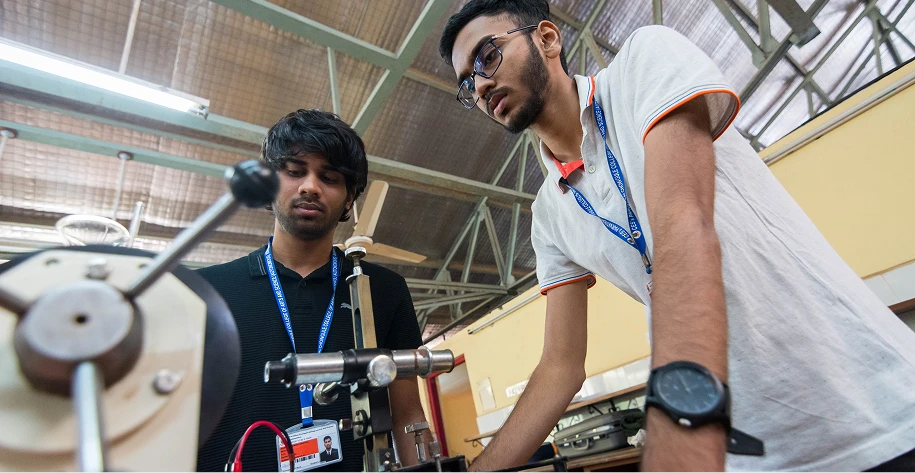
The B.Sc. Physics programme aims to provide students with a strong foundation in fundamental and applied physics through a balanced combination of theory, laboratory work, and project-based learning. The programme is designed to develop analytical thinking, problem-solving skills, and a scientific approach to understanding physical phenomena.
The curriculum covers core areas such as mechanics, electromagnetism, quantum mechanics, thermodynamics, solid-state physics, and electronics, along with hands-on laboratory training and exposure to computational and experimental techniques. Emphasis is placed on conceptual clarity, experimental skills, and the application of physics to real-world problems.
The programme also prepares students for higher education, research, teaching, and careers in industry, technology, and interdisciplinary fields.
- Program Specific Outcomes (PSO)
PSO-1: Strengthen understanding of Physics
Strengthen their understanding of core and applied areas of physics.
PSO-2: Solve complex problems.
Develop the ability to solve complex problems using mathematical and computational tools.
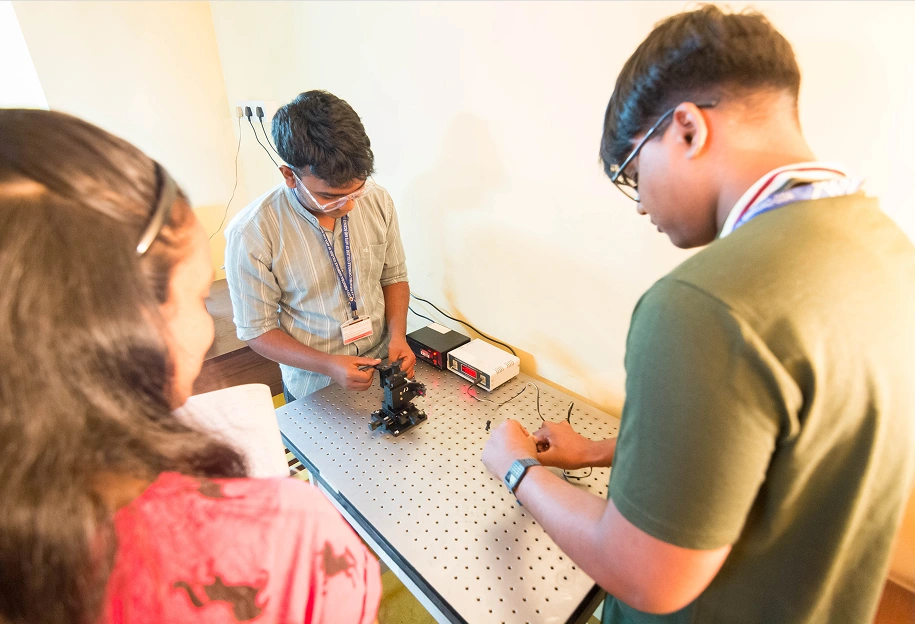
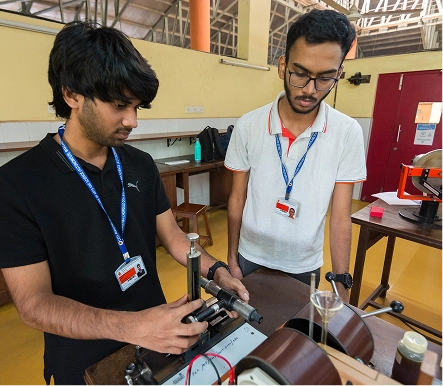
PSO-3: Hands-on experience in experimental physics
Acquire hands-on experience in experimental physics, demonstrating proficiency in laboratory techniques and analysis.
PSO-4: Scientific Communication Skills.
Effectively communicate scientific ideas, both in written and oral formats.
Course Structure
Internship of 4 credits should be completed in Semester IV and V
| Major Core | Minor/ Vocational | Multidisciplinary Course (MDC) | Value Added Course (VAC) | Skill Enhancement Course (SEC) |
|---|---|---|---|---|
|
UG-PHY-101: Mechanics-I |
UG-PHY-102: Mechanics, Sound and Properties of Matter |
UG-PHY-MDC1: General Physics: Fluids and Heat |
UG-PHY-VAC2: Environmental Physics |
UG-PHY-SEC1: Introduction to Mathematical Physics-I |
| Major Core | Minor/ Vocational | Multidisciplinary Course (MDC) | Value Added Course (VAC) | Skill Enhancement Course (SEC) |
|---|---|---|---|---|
|
UG-PHY-103: Electricity and Magnetism |
UG-PHY-104: Electricity, Magnetism and Electronics |
UG-PHY-MDC2: General Physics: Light and atoms |
UG-PHY-VAC1: Eminent Indian physicists and their contribution |
UG-PHY-SEC2: Introduction to Mathematical Physics-II |
| Major Core | Minor/ Vocational | Multidisciplinary Course (MDC) | Value Added Course (VAC) | Skill Enhancement Course (SEC) |
|---|---|---|---|---|
|
UG-PHY-201: Electromagnetic Theory-I UG-PHY-202: Optics UG-PHY-204: Oscillation, Waves and Sound |
UG-PHY-211: Wave Optics and Elementary Modern Physics |
UG-PHY- MDC3: General Physics: Nucleus, Relativity and Beyond |
|
UG-PHY-SEC3: Introduction to Error Analysis |
| Major Core | Minor/ Vocational |
|---|---|
|
UG-PHY-203: Modern Physics UG-PHY-206: Quantum Mechanics UG-PHY-207: Heat and Thermodynamics UG-PHY-208: Electronics-I UG-PHY-209: Properties of Matter and Acoustics UG-PHY-210: Introduction to Astronomy and Astrophysics |
UG-PHY- VOC1: Computational Physics |
| Major Core | Minor/ Vocational |
|---|---|
|
UG-PHY-301: Electromagnetic Theory-II UG-PHY-302: Solid State Physics UG-PHY-303: Thermodynamics and Statistical Mechanics |
UG-PHY-VOC2: Tools and Techniques for Computational Material Science UG-PHY- VOC3: Solid State Devices |
| Major Core | Minor/ Vocational |
|---|---|
|
UG-PHY-305: Atomic and Molecular Physics UG-PHY-306: Mechanics II UG-PHY-307: Nuclear and Elementary Particle Physics UG-PHY-308: Introduction to Special Theory of Relativity UG-PHY-PRJ: Project |
UG-PHY-VOC4: Instrumentation |
Career Opportunities
- Higher Education: M.Sc. Physics, Applied Physics, Materials Science, Electronics, Astrophysics, Data Science, and related interdisciplinary fields
- Research & Development: Research assistantships in academic institutions, national laboratories, and private R&D organisations
- Teaching & Education: Teaching at schools, coaching institutes, and academic support roles
- Industry & Technology: Electronics, instrumentation, semiconductor industries, renewable energy, and quality control
- Competitive Examinations: JAM, GATE, NET, SET, Civil Services, and other national-level examinations
- Emerging Fields: Data analysis, computational physics, scientific software, and technology-driven roles