Bachelor of Science (B.Sc.) in Chemistry
Established in 1962
Overview
The Department of Chemistry offers a contemporary three-year undergraduate B.Sc. degree programme under the autonomous framework of the College. The programme is designed to align with current academic, industrial, and societal needs by integrating conceptual understanding with experiential and application-based learning.
The curriculum spans core and advanced domains of Physical, Organic, Inorganic, and Analytical Chemistry, complemented by specialized elective courses such as Pharmaceutical Chemistry, Environmental Chemistry, Nanotechnology, Spectroscopy, and other emerging interdisciplinary areas.
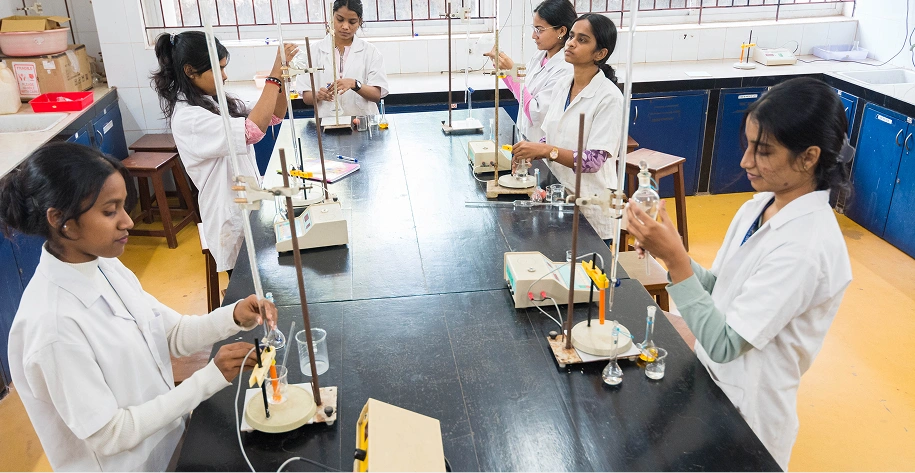
A total of 28 courses are offered, including internships and a research-focused Level 4 credit project, enabling students to gain hands-on experience, research exposure, and domain-specific expertise. Laboratory components are carefully structured to strengthen experimental precision, safety practices, and scientific documentation skills.
The Department actively promotes holistic learning through seminars, guest lectures, workshops, industrial interactions, and annual intercollegiate academic events. Innovative teaching-learning practices supported by ICT tools enhance conceptual clarity, critical thinking, and learner engagement.
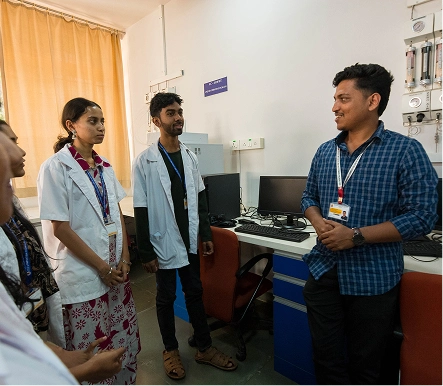
Industry-linked internships provide students with real-world exposure, professional ethics, and workplace readiness. With 100% of the faculty holding Ph.D. degrees, students benefit from mentoring and advanced research guidance across diverse specializations in Chemistry.
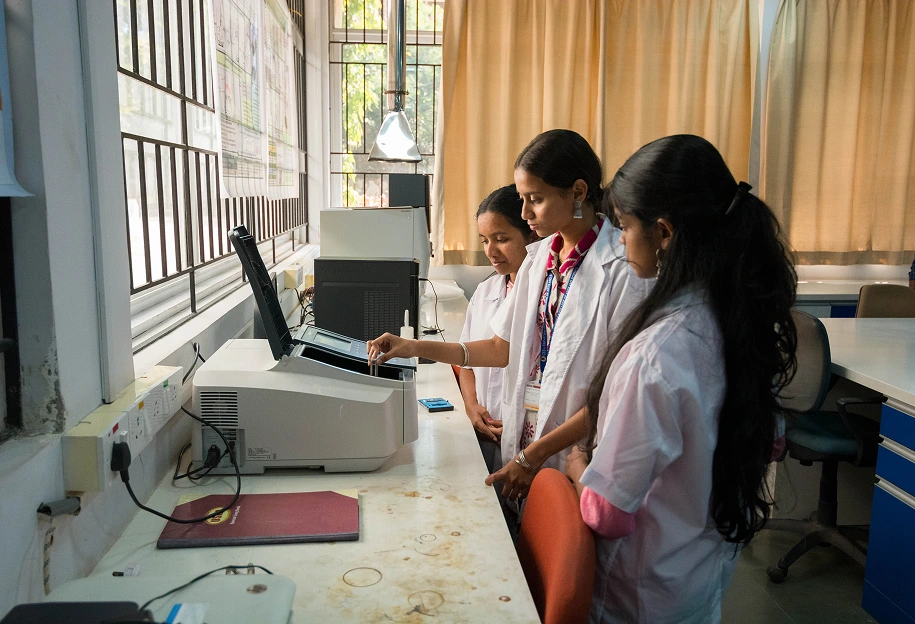
State-of-the-art laboratory infrastructure, including UV–Visible spectrophotometers, polarimeters, potentiometers, conductometers, and pH meters, enables students to acquire robust instrumental and analytical competencies. Students are trained to independently operate instruments and undertake research-oriented projects in their chosen areas.
- Program Specific Outcomes (PSO)
PSO-1: Development of Practical Laboratory Skills
PSO-2: Integrative Problem-Solving in Chemistry
PSO-3: Advanced Analytical Skills
PSO-4: The Role of Chemistry in Global Sustainability
Course Structure
Internship of 4 credits should be completed in Semester IV and V
| Major Core | Minor/ Vocational | Double Major | Multidisciplinary Course (MDC) | Value Added Course (VAC) | Skill Enhancement Course (SEC) |
|---|---|---|---|---|---|
|
UG-CHE-101: General Chemistry-I |
UG-CHE-101: General Chemistry-I |
|
UG-CHE-MDC1: Basics in Chemistry UG-CHE-MDC2: Essentials of Chemistry |
UG-CHE- VAC1: Environmental monitoring UG-CHE- VAC2: Ethics in science |
UG-CHE-SEC2: Basic Laboratory Methods and Safety in Chemistry
|
| Major Core | Minor/ Vocational | Double Major | Multidisciplinary Course (MDC) | Value Added Course (VAC) | Skill Enhancement Course (SEC) |
|---|---|---|---|---|---|
|
UG-CHE-102: General Chemistry-II |
UG-CHE-102: General Chemistry-II |
|
UG-CHE- MDC1: Basics in Chemistry UG-CHE- MDC2: Essentials of Chemistry
|
UG-CHE- VAC1: Environmental monitoring UG-CHE- VAC2: Ethics in science |
UG-CHE-SEC3: Chemistry of Water and Soil |
| Major Core | Minor/ Vocational | Double Major | Multidisciplinary Course (MDC) | Value Added Course (VAC) | Skill Enhancement Course (SEC) |
|---|---|---|---|---|---|
|
UG-CHE-201: Concepts in Chemistry-I UG-CHE-202: Concepts in Chemistry-II
|
UG-CHE-207: Concepts in Chemistry-III |
|
UG-CHE- MDC5: Fundamentals of Chemistry |
|
UG-CHE-SEC4: Basics of Analytical Chemistry |
| Major Core | Minor/ Vocational | Double Major |
|---|---|---|
|
UG-CHE-203: Selected Topics in Physical Chemistry UG-CHE-204:Selected Topics in Organic Chemistry UG-CHE-205: Selected Topics in Inorganic Chemistry UG-CHE-206: Introduction to Pharmaceutical Chemistry
|
UG-CHE -VOC1: Spectroscopic Techniques
|
UG-CHE-203: Selected Topics in Physical UG-CHE-205: Selected Topics in Inorganic Chemistry
|
| Major Core | Minor/ Vocational | Double Major |
|---|---|---|
|
UG-CHE-301: Advanced Physical Chemistry -I UG-CHE-302: Advanced Organic Chemistry -I UG-CHE-303: Advanced Inorganic Chemistry -I
|
UG-CHE -VOC2: Analytical techniques |
UG-CHE-301: Advanced UG-CHE-302: Advanced Organic Chemistry -I
|
| Major Core | Minor/ Vocational | Double Major |
|---|---|---|
|
UG-CHE-304: Advanced Physical Chemistry -II UG-CHE-305: Advanced Organic Chemistry -II UG-CHE-306: Advanced Inorganic Chemistry -II UG-CHE- PRJ: Project UG-CHE-307: Environmental and sustainable chemistry
|
|
UG-CHE-PRJ: Project UG-CHE-307: Environmental and sustainable chemistry
|
- Faculty of Life Science
Department of Chemistry
Established in 1962, the Department of Chemistry upholds a strong tradition of academic excellence and research, fostering skilled graduates with outstanding academic and professional achievements.
FAQ’s
What type of institution is Chowgule College?
The Department of English, Parvatibai Chowgule College of Arts and Science(Autonomous), began in 1962 as one of the first and oldest running department.
What type of institution is Chowgule College?
The Department of English, Parvatibai Chowgule College of Arts and Science(Autonomous), began in 1962 as one of the first and oldest running department.
What type of institution is Chowgule College?
The Department of English, Parvatibai Chowgule College of Arts and Science(Autonomous), began in 1962 as one of the first and oldest running department.
What type of institution is Chowgule College?
The Department of English, Parvatibai Chowgule College of Arts and Science(Autonomous), began in 1962 as one of the first and oldest running department.
What type of institution is Chowgule College?
The Department of English, Parvatibai Chowgule College of Arts and Science(Autonomous), began in 1962 as one of the first and oldest running department.
Career Opportunities
Graduates of the B.Sc. Chemistry programme are equipped with strong theoretical knowledge, practical skills, and analytical competence, enabling them to pursue diverse career pathways. Career opportunities include:
- Employment in chemical, pharmaceutical, agrochemical, polymer, food, and petroleum industries.
- Roles in quality control, quality assurance, analytical laboratories, and research and development (R&D) units.
- Opportunities in government and semi-government organizations such as Pollution Control Boards, forensic laboratories, customs, and regulatory agencies.
- Careers in environmental monitoring, water and soil testing laboratories, and sustainability-focused organizations.
- Positions in academic and research institutions after pursuing higher education (M.Sc., Ph.D.).
- Competitive examinations such as NET, SET, GATE, JAM, and civil services.
- Entrepreneurship in chemical-based startups, laboratories, and consultancy services.
- Employment in allied sectors including biotechnology, healthcare diagnostics, materials science, and nanotechnology.