Department of BVoc in Software Development

Established in 1986

Overview

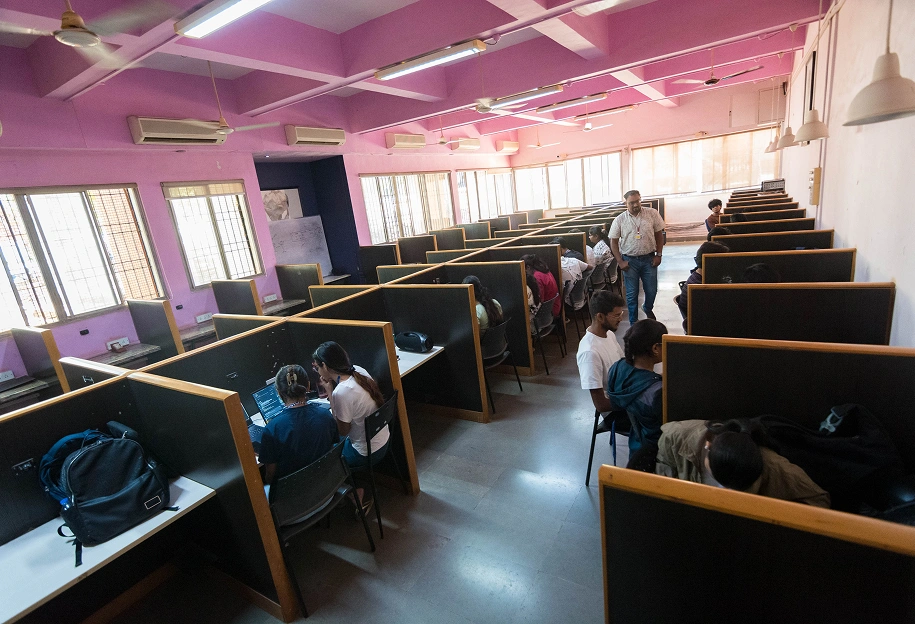
BVoc in Software Development is a unique program with the aim to produce individuals equipped with all the skills that are required for employability in various domains of the IT industry. The program offers a blend of skills education, professional education and general education required for all round development of the individual in the field of software Development. It is a three years Degree program with exit options at the first year with Diploma certificate, second year with advanced Diploma certificate and BVoc degree at the completion of three years.

Vision and Mision

To empower learners from diverse educational backgrounds with industry-ready software development skills, fostering logical thinking, digital competence, and lifelong employability in the evolving technology-driven world.

Eligibility and Selection Procedure:

To be eligible for admission to the programme leading to the award of Graduate in Bachelor of Vocational , Software Development the candidate must have passed 10+2 in Science, Commerce, Arts, Vocational, Open School or Home Schooling securing a minimum of 45% marks on aggregate or equivalent Grade or as specified for a Programme.

Programmes Offered​

Read More

Department Faculty

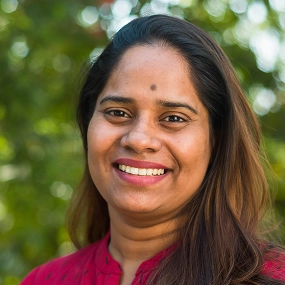
Mr
Mr
SS_PCCAS Faculty_Jan2026-155 1
SS_PCCAS Faculty_Jan2026-156 1
Mr

Activities Organised

For Enquiries & Further Info, Please Contact:

The Department of Mathematics adopts a blended and student-centric approach to teaching and learning, aimed at enhancing conceptual understanding and analytical skills. The methods employed include:

  • Lecture Method for systematic introduction of mathematical concepts and theories
  • Discussion Method to encourage critical thinking and active classroom participation
  • Flipped Classroom approach to promote self-learning and deeper in-class engagement
  • Problem-Solving Method through regular practice, assignments, and guided exercises
  • Student Presentations to develop communication skills and mathematical reasoning
  • Real-Life Applications to connect mathematical theory with practical scenarios
  • Software Training using mathematical and computational tools to enhance applied learning

These methods collectively foster independent learning, problem-solving ability, and academic preparedness.

Best Practices

The Department of Mathematics follows several best practices to strengthen conceptual understanding, analytical thinking, and independent learning among students.

  • Relating Mathematics to Real Life: Mathematical concepts are consistently linked to real-life situations and practical applications to enhance relevance and student engagement.
  • Activity-Based Learning: Classes include problem-based and activity-oriented tasks that encourage active participation, logical reasoning, and collaborative learning.
  • Mandatory Textbook Reading: Students are required to regularly read standard textbooks and solve assigned problems to develop mathematical maturity and self-discipline.
  • Emphasis on Problem Solving: Regular assignments, in-class problem-solving sessions, and guided practice form a core component of instruction.
  • Student Presentations: Learners are encouraged to present solutions and topics, fostering clarity of thought and confidence in mathematical communication.
  • Use of Technology: Mathematical software and digital tools are integrated to support visualization, computation, and applied learning.
  • Continuous Mentoring: Faculty provide academic guidance and individualized support to help students progress towards higher studies, research, and professional goals.

These practices collectively create a rigorous yet supportive learning environment that promotes deep understanding and academic excellence.

Scroll to Top