- FACULTY OF LANGUAGES AND LITERATURE
Department of PG English
The PG Department of English of CES’s Parvatibai Chowgule College of Arts and Science (Autonomous) began in 2018 with its programme, M.A. in English.
Overview
The PG Department of English of CES’s Parvatibai Chowgule College of Arts and Science (Autonomous) began in 2018 with its programme, M.A. in English. The central ideology behind its initiation is to offer a high quality English Literature programme that highly-driven students normally travel out of Goa for. It is driven by its core objective to equip the students with in-depth knowledge. The syllabi has been specially designed to bridge the gap between education and industry. The programme emphasizes in literature courses, skill-based courses, and contemporary literary courses

Vision
To be a centre of academic excellence, where students are encouraged to develop their language and literary skills, to nurture their creativity so as to have a encompassing vision of life to make a mark in society
Mission
As educators, our mission is multi-fold in nature. We aim to facilitate higher order thinking and critical thinking skills through experiential observations and research. We hone their inter-personal, organizational, and managerial skills through events and activities through the departmental activities and course work. We mold our students to be equipped with career skills related to linguistics, research, allied media, and education. We strongly believe that our programme contributes to the overall development of an individual’s empathy, ethics, and empathy as members of society.
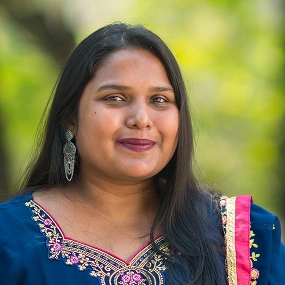
Department Faculty
Activities Organised
Since its formulation, The PG English department has organised events alongside its sister department. The department has organised a series of academic and creative activities aimed at enhancing students’ linguistic competence, critical thinking, and literary skills. These activities included interactive lectures, student presentations, group discussions, creative performances, and skill-based workshops. The students have attended various conferences, seminars, workshops and through participatory methods such as seminars, gallery walks, enactments, and multimedia presentations, students were encouraged to engage actively with literary texts, language theories, and cultural contexts. The activities fostered collaborative learning, improved communication skills, and provided a platform for students to apply theoretical knowledge in innovative and practical ways. The department has organised events as well as peer friendly competitions for holistic learning and enriched the academic environment of the department.
- Book Chats
- Conferences/Seminars
- Performances
- Gallery walks
- Workshops
- Literary talks
- Events
- Play and Movie screenings
- Competitions
- Trip to comic con and Kala Ghoda
Teaching & Learning method
The PG Programme delves more towards student- centric teaching and learning as the Teaching and learning methods in postgraduate English Literature and Language are designed to cultivate advanced critical thinking, theoretical engagement, and independent lesrning. The instruction moves beyond lecture-based delivery to include seminar-style discussions, close textual analysis, flipped classroom methodology, enactments and theory-driven interprettations that encourage students to engage with texts in their historical, cultural, and linguistic contexts. Performance-based learning, play enactments, dualrole and dramatized readings are used to deepen understanding of drama and narrative techniques, while gallery walks, student-led presentations and workshops, and collaborative projects promote peer learning and interdisciplinary thinking. Digital tools such as film and play screenings, academic research videos, podcasts, and Open Educational Resources (OER) support multimodal learning. Research-oriented activities, including research essays, socratic seminars, critical reviews, and reflective writing, further strengthen analytical, methodological, and academic writing skills essential for postgraduate study, it helps our students write as well as review research papers. The methodology looks at holistic development for a smooth transition from academia to work place.