M.Sc. Analytical Chemistry
The two year post graduate degree programme in M.Sc. Analytical Chemistry, stands as a centre of academic excellence, research innovation, and skill-oriented training.
Overview
The two year post graduate degree programme in M.Sc. Analytical Chemistry, stands as a centre of academic excellence, research innovation, and skill-oriented training. The department focuses on producing skilled analytical chemists prepared for careers in pharmaceutical industry, quality control, higher education, and research. One of its primary strengths lies in its flexible, outcome-based curriculum, enabled by its autonomous status, which allows timely incorporation of emerging areas such as advanced spectroscopic techniques, chromatographic methods, electroanalytical methods, nanomaterial characterization, and environmental analysis. The syllabus is regularly updated to align with industry requirements, research trends, and national educational policies.
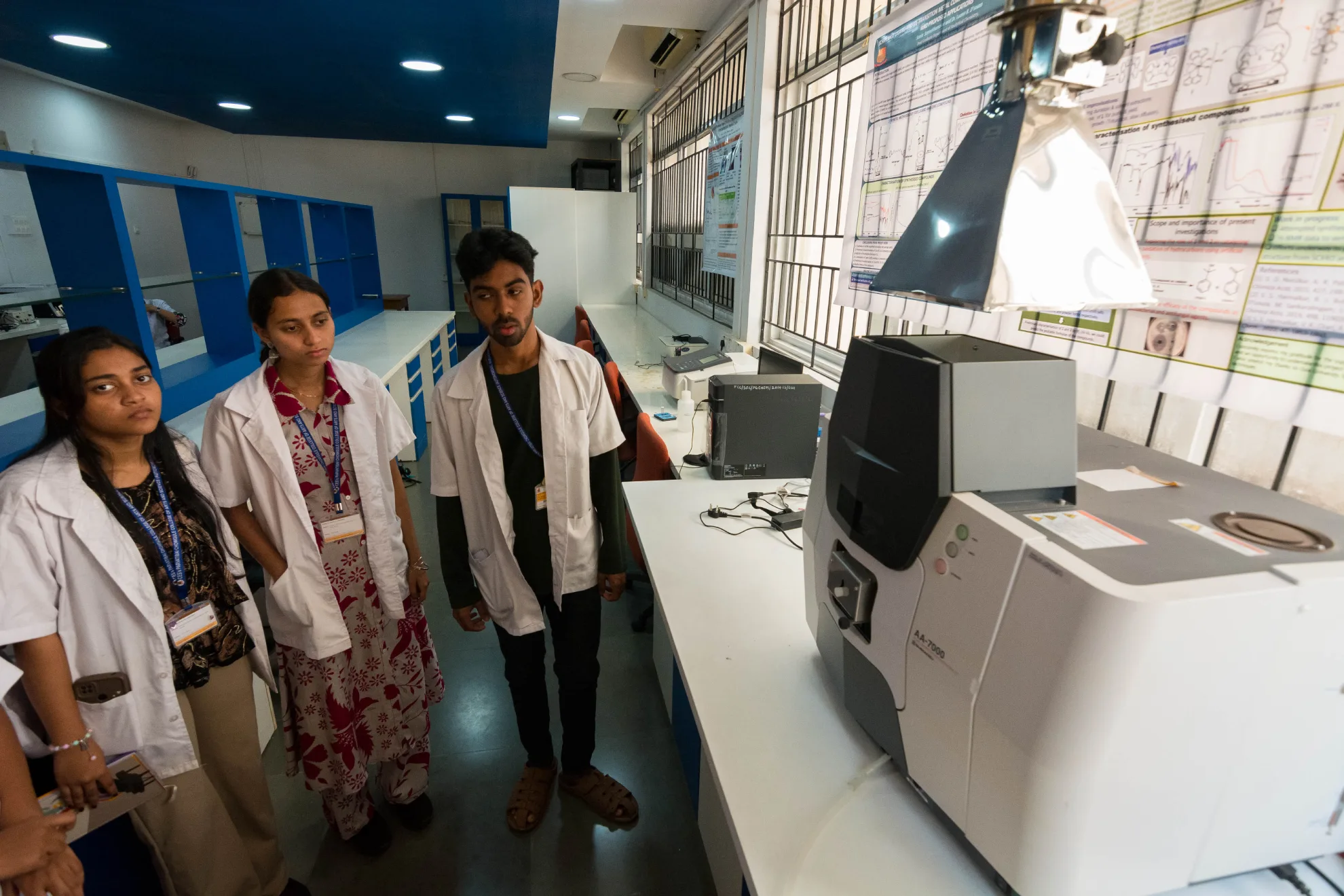
The department is strengthened by well-qualified and research-active faculty members and sophisticated instrumentation facilities such as UV-Visible spectroscopy, TG, FTIR, HPLC, and AAS which provide hands-on training, enhancing students’ skill in analytical competence and imparting technical confidence. A strong research culture encourages postgraduate dissertations addressing real-world problems in pharmaceuticals, food analysis, environmental monitoring, and materials chemistry. The department also fosters interdisciplinary collaboration, industry interaction, internships, and skill-development workshops.
Effective mentoring, continuous internal assessment, and a supportive academic environment contribute to excellent academic performance and placement outcomes. Through academic rigor, research orientation, and industry-based internships, the department continually strives to fulfil its goal of training the students to become skilled chemists prepared for any career in the field of analytical chemistry.

- Program Specific Outcomes (PSO)
PSO-1: Hands on expertise in Analytical Instrumentation
PSO-2: ntegrating analytical knowledge with chemical, pharmaceutical and food industry.
Course Structure
Internship of 4 credits should be completed in Semester IV and V
| Course Code | Course Title | Course Type |
|---|---|---|
|
PGMP-CHE-DSC-401 |
General Inorganic Chemistry |
DSC |
|
PGMP-CHE-DSC-402 |
General Physical Chemistry |
DSC |
|
PGMP-CHE-DSC-403 |
Fundamentals of Organic Chemistry |
DSC |
|
PGMP-CHE-DSC-404 |
Laboratory Course in Physical Chemistry |
DSC |
|
PGMP-CHE-DSC-405 |
Laboratory Course in Organic Chemistry |
DSC |
|
PGMP-CHE-DSE-401 |
Reaction Mechanisms in Organic Chemistry |
DSE |
|
PGMP-CHE-DSE-402 |
Topics in Physical Chemistry |
DSE |
|
PGMP-CHE-DSE-403 |
Diffraction Methods |
DSE |
| Course Code | Course Title | Course Type |
|---|---|---|
|
PGMP-CHE-DSC-406 |
Spectroscopy in Chemistry |
DSC |
|
PGMP-CHE-DSC-407 |
Fundamentals of Chemical Analysis |
DSC |
|
PGMP-CHE-DSC-408 |
Spectral Methods of Analysis |
DSC |
|
PGMP-CHE-DSC-409 |
Laboratory Course in Analytical Chemistry |
DSC |
|
PGMP-CHE-DSC-410 |
Laboratory Course in Inorganic Chemistry |
DSC |
|
PGMP-CHE-DSE-404 |
Topics in Inorganic Chemistry |
DSE |
|
PGMP-CHE-DSE-405 |
Reagents in Organic Synthesis |
DSE |
|
PGMP-CHE-DSE-406 |
Bio Analytical Chemistry |
DSE |
| Course Code | Course Title | Course Type |
|---|---|---|
|
PGMP-CHE-DSE-501 |
Calibrations and Validation |
DSE |
|
PGMP-CHE-DSE-502 |
Methods of Analysis |
DSE |
|
PGMP-CHE-DSE-503 |
Advanced NMR Spectroscopy |
DSE |
|
PGMP-CHE-DSE-504 |
Separation Techniques |
DSE |
|
PGMP-CHE-DSE-505 |
Quality Assurance and Quality Control in Analytical Chemistry |
DSE |
|
PGMP-CHE-DSE-506 |
Chemometrics |
DSE |
|
PGMP-CHE-DSRE-501 |
Research Methodology & Academic writing |
DSRE |
|
PGMP-CHE-DSRE-502 |
Experiments in Analytical Chemistry |
DSRE |
|
PGMP-CHE-DSRE-503 |
Experiments on Analytical Instrumentation |
DSRE |
|
PGMP-CHE-GE-501 |
Food chemistry and Nutrition |
GE |
|
PGMP-CHE-GE-502 |
Environmental Chemistry |
GE |
|
PGMP-CHE-GE-503 |
Applied Chemistry |
GE |
| Course Code | Course Title | Course Type |
|---|---|---|
|
PGMP-CHE-DSRE-504 |
Synthesis of Inorganic Materials |
DSRE |
|
PGMP-CHE-DSRE-505 |
Catalysis |
DSRE |
|
PGMP-CHE-DSRE-506 |
Applied Organic Chemistry |
DSRE |
|
PGMP-CHE-DSRE-507 |
Nanomaterials |
DSRE |
|
PGMP-CHE-DSR/I-501 |
Discipline Specific |
DSC |
|
Research or Internship |
||
- Faculty of Life Science
Department of Chemistry
Established in 1962, the Department of Chemistry upholds a strong tradition of academic excellence and research, fostering skilled graduates with outstanding academic and professional achievements.
Teaching and Learning Methods
- Interactive classroom teaching supported by ICT tools such as presentations, videos, and virtual laboratory demonstrations.
- Faculty members employ outcome-based education (OBE), clearly defining course outcomes and aligning teaching strategies and assessments accordingly.
- Interactive pedagogies such as group discussions, problem-solving sessions, case studies, and seminar presentations encourage critical thinking and active participation.
- Laboratory-intensive training provides hands-on experience with advanced analytical instruments such as chromatography, spectroscopy, and electroanalytical systems.
- Projects, internships, industrial visits, and dissertation work expose students to real-world applications and research methodologies.
- Guest lectures, seminars, and workshops by academicians, industry experts, and research professionals.
- Continuous internal assessment including quizzes, assignments, open-book tests, and practical evaluations ensures regular academic engagement.
- Emphasis on soft skills, scientific communication, ethics, teamwork, and environmental awareness through outreach activities and extension programs.
Career Opportunities
- Analytical Chemist
– Industry/Chemical Laboratories: Instrumental analysis using techniques like HPLC, GC, UV-Vis, AAS, ICP, etc. in testing laboratories. - Pharmaceutical Industry
– Quality Control (QC) Officer: Testing raw materials and finished products in pharmaceutical, chemical, food, and cosmetic industries.
– Quality Assurance (QA) Executive: Ensuring compliance with GMP, GLP, ISO standards, and regulatory documentation. - Research Scientist / Research Associate: Working in R&D laboratories in academia or industry.
- Environmental Analyst: Water, soil, and air quality analysis in environmental monitoring labs or pollution control boards.
- Forensic Scientist: Chemical analysis of evidence in forensic laboratories.
- Clinical Research Associate: Analytical testing in biomedical and clinical research labs.
- Regulatory Affairs Executive: Handling documentation and compliance for regulatory bodies.
- Academic Career (NET/SET Qualified): Assistant Professor, Lecturer, or pursuing Ph.D.
- Government Jobs: Positions in public sector labs, pollution control boards, DRDO, ISRO, CSIR labs, etc.
Entrepreneurship: Starting an analytical testing laboratory or consultancy services.